

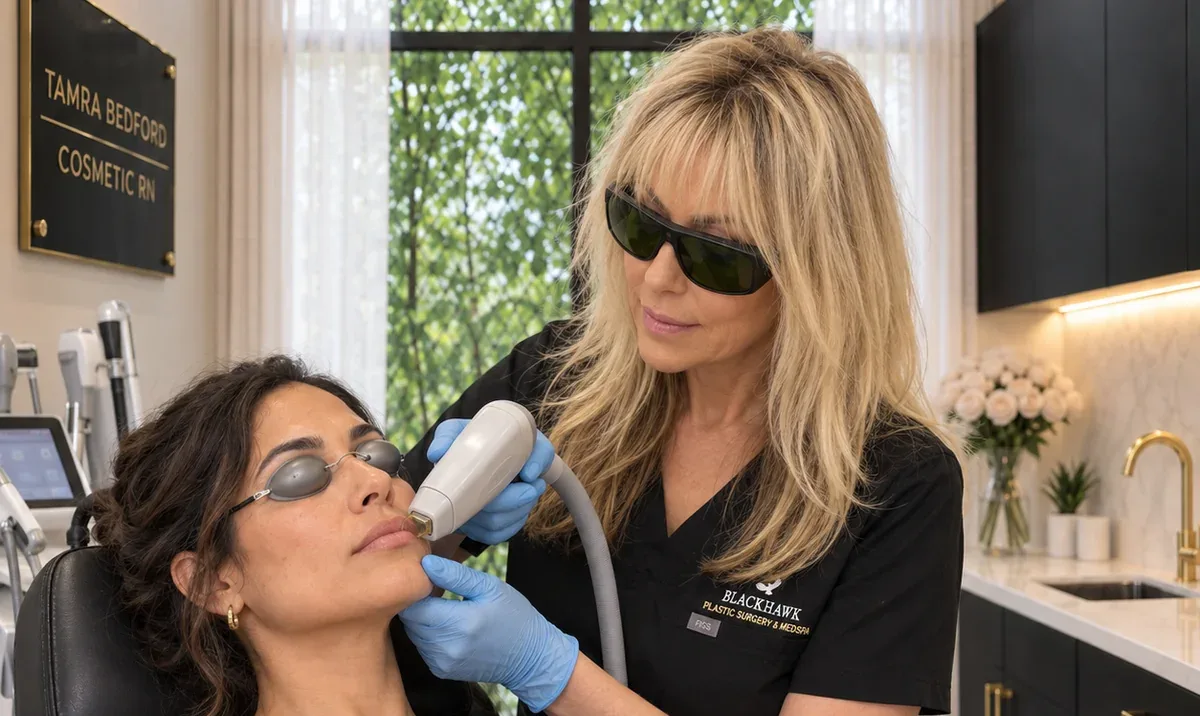
Written by Tamra Bedford, RN, a cosmetic nurse with 20+ years in aesthetics and over 20,000 laser treatments behind her.
If you have brown, olive, or deep skin, you've probably heard some version of "laser isn't for you." Maybe a friend got burned. Maybe a clinic told you to come back in winter, or not to bother at all. I see it all the time in clients who've gone elsewhere first, and I understand why so many people walk into a laser hair removal consultation with me already nervous.
Darker skin can be treated safely, and treated well. It takes the right laser in the hands of someone who sets it for you instead of running a preset.
The laser has to tell your hair apart from your skin
Laser hair removal works by sending light into the skin, where pigment absorbs it. Ideally that pigment is the dark melanin in your hair follicle. It heats up. The follicle stops making hair. The catch is that your skin has melanin too. The darker your skin, the more of the laser's energy the surface can soak up before it ever reaches the follicle.
That's where burns, blisters, and dark or light patches come from.
Darker skin isn't fragile.
Some lasers just can't separate the hair they're aiming at from the skin around it.
Not every laser is built for deeper skin tones
Clinics use all sorts of devices. Intense pulsed light (IPL) and some shorter-wavelength lasers do a fine job on fair skin with dark hair, and they're often what's sitting in the treatment room. Their light gets absorbed by melanin near the surface, which is exactly what you don't want on tan or deep skin.
I use a Cutera CoolGlide, a long-wavelength YAG laser. Its light travels deeper and passes through the top layer of skin with less of it absorbed on the way, so more of the energy reaches the follicle and less stays at the surface. It's one of the few systems made to treat every skin tone, from very fair to very dark, and it handles tanned skin too. The tip of the handpiece is chilled, so the skin it touches stays cool. Most of my clients feel very little.
The settings matter as much as the machine
A good laser on the wrong settings can still hurt you. Every time I treat someone, I set the energy for their skin tone and for how coarse or fine their hair is. Thick dark hair on the legs and finer hair on the upper lip don't get the same treatment. Neither do two people with different skin.
Patients rarely see this part. Plenty of the bad experiences I hear about trace back to the same settings run on everyone, or a different person at every visit who didn't know how your skin reacted last time. I do every treatment myself, from your first session to your last. I know how your skin responded, and I adjust from there.
Patients with darker skin tell me the same few stories
When new clients come to me after a bad experience somewhere else, what went wrong tends to fall into a few buckets:
- A burn or blister after the first session. Usually the energy was too high for their skin, or the device wasn't a good match to begin with.
- Dark or light patches that took months to fade. Pigment changes are the most common problem I see on deeper skin, and sun makes them worse.
- Hair that came back, or seemed to grow in thicker. Doctors call this paradoxical hair growth. It's rare, but it shows up more on the face, in people with hormonal conditions like PCOS, and in darker skin, and it's mostly been linked to certain other laser types and IPL.
- Sessions that did nothing. Some clinics turn the energy way down so they won't burn darker skin. You stay safe, but the hair doesn't respond, and you keep paying for visits that don't get you anywhere.
That last one deserves a second look.
Turning the energy down isn't the same thing as treating you safely.
What you want is the right energy for your skin, on a laser that can deliver it.
Your consultation is where safety starts
First, we sit down together. I assess your skin type and hair type, review your medical history, and look at the area you want treated. We talk about your skin tone, your hair color and thickness, how you remove hair now, and what you'd like to end up with. Then I walk you through the plan: how many sessions you're likely to need and how far apart they should be.
If your skin is on the deeper side, bring these up:
- Dark marks that linger after acne, cuts, or bug bites. Skin that darkens easily needs extra care.
- Keloids or raised scars.
- Recent sun, tanning, or self-tanner.
- Medications or skincare that make you more sensitive to light, like retinoids.
- Hormonal conditions such as PCOS, which can change how facial hair responds.
New clients have their first visit at Blackhawk Plastic Surgery & MedSpa in Danville, where a physician sees you before your first treatment. Most sessions after that happen at my studio in San Ramon.
Sun protection does most of the work after a session
I'll give you instructions for before and after each treatment at your consultation. For darker skin, the one that matters most is sun protection. Treated skin stays more sensitive for a while, and sun on that skin is the most common reason pigment changes show up or hang around. Wear sunscreen on treated areas.
Every day.
If you've been in the sun or just got back from vacation, tell me before your session so we can adjust or reschedule.
If anything looks off afterward, like blistering or swelling that won't settle, call me. That's what I'm here for.
Results build over a series of sessions, whatever your skin tone
Hair grows in cycles, and the laser only reaches hairs in their active growth phase. So results come over several visits, not one. Most areas take five to seven sessions, usually four to six weeks apart, longer if your hair grows slowly, and coarse or dense hair can take a few more than that. With the right laser and settings, darker skin doesn't mean extra sessions. You'll see treated hairs shed in the weeks after each visit, and regrowth comes in finer and sparser as you go.
Darker skin is no reason to give up on smooth skin
I've spent more than 20 years in aesthetics. One lesson keeps coming back.
Who treats you, and with what, matters more than the color of your skin.
If you've been told no before, or had a rough experience somewhere else (here's what the big laser chains don't tell you), come talk to me. No pressure. I'll look at your skin and hair, tell you honestly what to expect, and you can decide from there. You can read more about how I work on my laser hair removal page, or reach out to book your consultation.